EV Charging for Fleet and Commercial Use
7 Mins Read
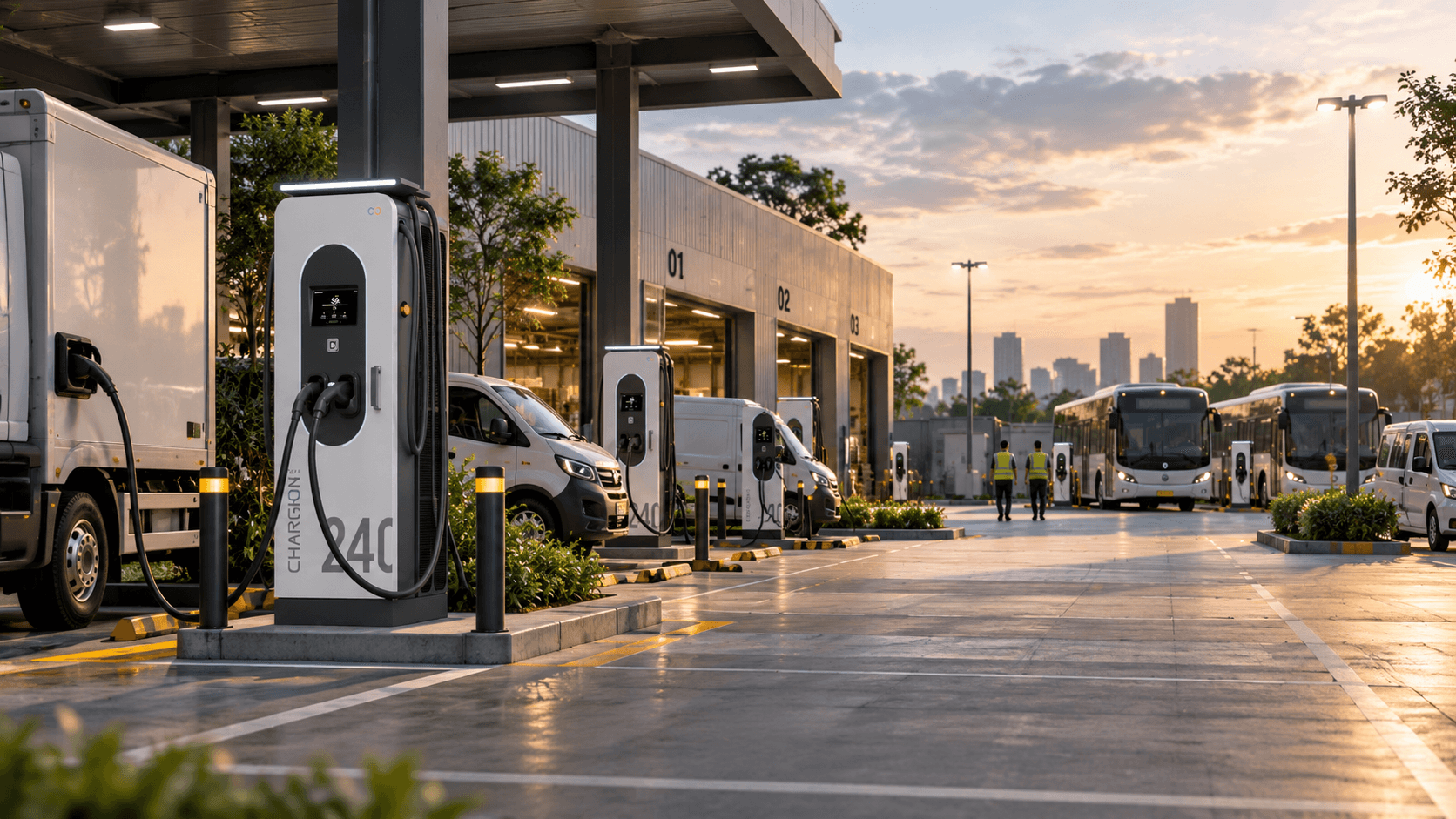
Fleets are one of the fastest-growing segments in EV charging. Delivery companies, taxi operators, bus depots, logistics firms and corporate campuses are all moving to electric vehicles, and every vehicle needs a reliable place to charge.
For charger vendors, this means larger orders, repeat business and long-term service contracts.
What Is Fleet Charging?
Fleet charging means installing chargers for a group of commercial vehicles that run on a schedule. Unlike a home user, a fleet operator cares about uptime, cost per kilometre, and how many vehicles can be ready at the start of each shift.
Types of Fleets and Their Charging Needs
| Fleet type | Typical vehicles | Charging pattern | Suitable charger |
|---|---|---|---|
| Electric buses | City and intercity buses | Overnight depot charging, some opportunity charging | High-power DC (60 to 240 kW+), multi-gun setups |
| Taxi and ride-hailing | Cars, SUVs | Short top-ups between trips, plus night charging | DC fast (30 to 60 kW) and AC (11 to 22 kW) |
| Delivery and logistics | Vans, mini trucks, e-cargo | Overnight depot charging | AC 11 to 22 kW, DC 30 kW for quick turnaround |
| Last-mile delivery | E-two-wheelers, three-wheelers | Frequent short charges or battery swapping | Low-power AC, light-EV DC chargers |
| Corporate and staff shuttles | Cars, mini buses | Daytime charging while parked | AC 7.4 to 22 kW |
| E-rickshaws | Three-wheelers | Overnight charging | Low-voltage DC or AC chargers |
Depot Charging vs Opportunity Charging
1. Depot charging :
Vehicles charge overnight at the fleet's own base. AC or moderate-power DC is enough, and electricity costs are lower at night.
2. Opportunity charging :
Vehicles charge briefly during the day at fast chargers to extend range. This needs higher-power DC.
Most fleets combine both. Depot charging handles the bulk of energy, and fast charging fills gaps.
Key Features Fleet Operators Look For
Reliability and uptime
- Robust build for daily, heavy use
- Remote diagnostics and quick service support
- Spare parts availability
Smart management
- OCPP support and a central dashboard
- Load balancing so many chargers do not overload the site supply
- Scheduled charging to use cheaper tariff hours
- Vehicle-wise and driver-wise charging reports
Access and billing
- RFID or app-based authorization per driver or vehicle
- Energy metering for accurate cost tracking
- Integration with fleet management software
Scalability
- Modular DC chargers that can be upgraded
- Layout planned so more chargers can be added later
Planning a Fleet Charging Site
1. Study the fleet :
Number of vehicles, battery sizes, daily distance and shift timings.
2. Calculate energy needs :
Total daily kWh and peak power demand.
3. Check power supply :
Transformer capacity, sanction load and grid upgrades.
4. Choose the charger mix :
AC for overnight, DC for quick turnaround.
5. Plan the layout :
Parking, cable management, safety clearance and vehicle movement.
6. Add software :
OCPP backend, load management and reporting.
7. Plan for growth :
Leave room and electrical capacity for future vehicles.
Business Benefits for Fleet Operators
- Lower running cost per kilometre than diesel or petrol
- Predictable energy costs with scheduled charging
- Full control over charging, instead of depending on public stations
- Better data on energy use and vehicle performance
- Support for green targets and government incentives
Opportunity for White-Label Vendors
- Large orders: a single depot may need dozens of chargers.
- Repeat business: fleets expand, so orders grow over time.
- Recurring revenue: software, maintenance contracts and upgrades.
- Customization: fleet clients often want specific connectors, power levels, branding and software integration, which suits white-label manufacturing.
- Growing demand: logistics, e-commerce, public transport and ride-hailing are all electrifying.
Vendors can offer packages such as a depot charging kit (AC chargers, load management and app), a fast-charging hub for taxis and delivery vans, or bus depot solutions with high-power DC.
Common Challenges and Solutions
| Challenge | Solution |
|---|---|
| Limited grid capacity at the depot | Load balancing, phased installation, staggered charging |
| High electricity demand charges | Scheduled charging and peak-load control |
| Downtime affecting operations | Remote monitoring and quick service support |
| Mixed vehicle types | Multi-connector and flexible power chargers |
| Driver and vehicle tracking | RFID and backend reporting |
FAQs
1. Which charger is best for a delivery fleet?
It depends on usage. Overnight depot charging works well with 11 to 22 kW AC chargers. For vehicles that need quick turnaround, add 30 kW or higher DC chargers.
2. How many chargers does a fleet need?
It depends on the number of vehicles, battery size and the time available to charge. A charger-to-vehicle ratio is worked out from daily energy needs and shift schedules.
3. Is OCPP necessary for fleets?
Yes, for anything beyond a very small setup. It allows remote control, load management and reporting.
4. Can fleet chargers be customized?
Yes. Power rating, connectors, branding, firmware and software integration can be tailored, which is where a white-label manufacturer adds value.
Planning to supply chargers for fleets, bus depots or commercial sites? We manufacture AC and DC chargers under white-label, with custom power ratings, OCPP and software options. Contact us to discuss your fleet charging requirements and get a quote.